Posts tonen met het label Dove. Alle posts tonen

vrijdag 13 juli 2012

Dove: Tobias and the Angel

I've been unable to muster a lot of concentration and focus in my listening over the last few weeks. June was largely dedicated to travelling, including a week-long solo bicycle trek through France. On the road I happily limited myself to re-listening again and again to Autumn Chorus' The Valley to the Vale and the new Sigur Ros album, Valtari. These gently epic pieces resonated very well with the placid landscapes that unfolded before my eyes.

Also, it seems I have moved temporarily out of Debussy's orbit in which I have been thankfully circling for almost nine months. It's not that I'm feeling in any way tired of his music, but there is a faint urge to explore some new horizons. That isn't too difficult as I have literally stacks of CDs and LPs with unfamiliar repertoire waiting for a first audition. Recently I took advantage of a Presto Classical promotion of Chandos albums. One of the discs I purchased is Tobias and the Angel, a single-act opera by British composer Jonathan Dove. I listened to his Siren Song last autumn and was favourably impressed. I also have Flight in my collection, but haven't gone through that yet. With Tobias I have access to all of his stage works available on CD (his Pinocchio is only on DVD).

It took me a while to warm to this piece. Siren Song had charmed me because of the keen sense of drama, the compelling psychology and the fresh, humane vocal writing. Musically it is not an overpowering experience. Dove's ideas are cloaked in an attractive, accessible and discreet minimalism that doesn't seem to be interested in scaling Himalayan heights. Tobias and the Angel initially struck me as slightly too episodic to hold my attention. Siren Song had the advantage of a very limited cast. It's a chamber opera that revolves around essentially three characters. The claustrophobic quality of this setting significantly adds to the quality of the drama. Tobias is a church opera, written by Dove in the late 1990s for a Birmingham parish as a canvas for community participation. So it's conceived for a much larger and more differentiated cast, including multiple choruses. (The supporting instrumental ensemble, however, is as lean as in the case of Siren Song. It consists of a single violin, cello, double-bass, harp, organ, accordion, clarinet, flute, with percussion on top.) I must admit of listening the first couple of times without having read the libretto. As the the story is a rather caleidoscopic affair that shifts between locations and perspectives, this certainly contributed to my initial sense of disorientation. Given the setting for which it was composed the ambience is also less serious and introspective compared to Siren Song. At times it veers into Broadway. There is ostentatious reliance on Klezmer style

However, after having listened to the piece a couple of times (initially mostly in the car) and after having read the synopsis of the story I started to get the hang of it. I recognised that, as in the other work, there is a compelling triadic relationship at the heart of the piece. Here it is between Tobias, an insouciant youth, Sara, a possessed beautiful young lady and Raphael, an angel (sung by a countertenor). The latter has a mystical relationship with visible reality and hence the trees, rivers and mountains play a decisive and musical role. That is similar to Siren Song, where the omnipresent sea assumes a genuinely important dramatic persona.

The piece really comes up to speed after an initial part that is mostly dominated by the forces of darkness. Tobias and Raphael undertake a journey which turns out to be some sort of vision quest and puts the drama on an exalted footing. Dove is able to maintain and deepen that ambience of quiet ecstasy as the drama unfolds. This culminates in a finale that is showered by a heavenly blaze of compassion and joy.

The production recorded by Chandos seems to me exemplary on all accounts. Great and engaging singing from the large vocal forces involved (with a special mention of counter-tenor James Laing), an instrumental ensemble that is very much on top and everything firmly in the hand of American conductor David Charless Abell. The recording leaves nothing to be desired too.

Once I was into the piece it was difficult to get it out of my head. I think over time I will learn to love it more than Siren Song. This is contemporary music that is utterly accessible. There is nothing highbrow about it. But it inspires, fills our minds with light and makes us pause. I'm not asking for more.

vrijdag 21 oktober 2011

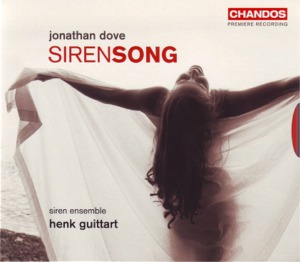
Dove: Siren Song

Siren song: this immediately opens up some Debussyean perspectives ...

Jonathan Dove is a contemporary British composer (born in 1959) of predominantly operatic works. Allegedly he has written more than 50 (!) of them, in a variety of formats, from the full-scale stage drama to television, chamber and community operas.

Dove appeared in one of my numerous search campaigns in the databases of Presto Classical or Amazon. Listening to the snippets online I liked what I heard and so I decided to acquaint myself with this composer's work via a shorter, single CD work. It has, by the way, been ages since I listened to opera.

Siren Song (an early work, written in 1994, when Dove was just 35) is a chamber opera developed around the reportedly true story of a sailor who became the victim of an elaborate hoax. Reacting to an add in a newspaper he struck up a correspondence with a British belle from Southampton. The girl, however, did not exist but happened to be a front for an impostor posing as her brother in order to obtain favours and money. This was in 1988, so before the advent of mobile telephony and internet. It's an intriguing story, full of deep resonances, that has been turned into a breezy libretto by the playwright Nick Dear. The work itself has a compact scale, requiring a cast of five singers (the sailor, the girl, the brother and two officials in cameo roles), and a band of only 10 players (flute/piccolo, oboe, clarinet, horn, piano/celesta, harp, percussion, violin, cello and double-bass). It plays in one continuous act, divided into seventeen quasi-cinematographic scenes, lasting about 75 minutes in total. 

Clearly Dove has a very lively dramatic instinct and he makes the music subservient to the unfolding narrative. This must be one of the only operas where I found myself truly following the story (easy enough as the singers' diction is so clear) rather than just considering it as a piece of absolute music with voices tacked on. I would describe the style of the music as minimalist. A mix of Adams, Reich and Glass that, surprisingly, doesn't sound trite. There are no big tunes, nothing that musically really jumps out. Instead we have a light, transparent, constantly shifting musical tapestry that is remarkably successful in supporting the action and creating an atmosphere that is shot through with dread and yearning. The vocal writing is very attractive, humane and lyrical, and an ideal foil for the young voices that are featured in this production: Brad Cooper's marvelously youthful tenor, Mattijs van de Woerd's credibly charlatanesque baritone and Amaryllis Dieltiens who, despite a background that is heavily tilted towards the Baroque repertoire,  puts down a suitably frivolous siren (Dieltiens is a Belgian soprano who started her musical education at the Leuven Lemmens Institute, here around the corner).

The recording has been made from live performances at the 2007 Grachtenfestival in Amsterdam. It is in all respects excellent. Voices and instruments are well placed and close enough to the microphones to make impact. There is minimal audience intrusion and stage noise. The instrumental ensemble, led by Henk Guittart (primarius of the Schoenberg Quartet until the ensemble's demise in 2009, amongst other achievements), works wonders. So altogether an excellent production that I will be happy to revisit. Meanwhile I have also ordered the Chandos recording of Dove's most notable success, a full-fledged airport comedy called Flight that has been commissioned by Glyndebourne Festival.

I want to briefly come back to those intriguing parallels between this work and Debussy's universe. A distinctive feature of the minimalist style is, of course, the recurring use of ostinatos (or ostinato networks). And this happens to be an important feature of Debussy's music as well. This may, in both instances, go back to the exotic influence of the Javanese gamelan (which Debussy famously heard at the Paris World Exhibition in 1889). Sirènes, the final part of his Nocturnes, is almost wholly built up as a composite ostinato, in which several ostinato-based strands unfold simultaneously. Only in the exact centre of the piece and in very few other isolated places they are absent (I have this from Richard Parks' essay 'Music's inner dance: form, pacing and complexity in Debussy's music' in the Cambridge Companion). Specifically in the context of Debussy's work Derrick Puffett has called this an 'ostinato machine': "a composite ostinato in which each of the separate strands pursues its own rhythmic/harmonic course, together creating a dense polyphonic structure. The 'machine' metaphor is apt as such structures tend to assume a kind of autonomy, unfolding alongside, or even in opposition to, whatever mode of organisation prevails for the piece as a whole." Also Dove's approach of spinning a differentiated, constantly changing musical fabric, without genuine climaxes or epiphanies, is very Debussy-like. (Late in his life, when working with a writer on a text for a cantata on Jeanne d'Arc, Debussy confessed that he 'was suspicious with respect to the exceptional').

Apart from this stylistic correspondence, there is also thematic overlap, it seems to me, with the world of Debussy. First of all, in Dove's opera as in Debussy's work, there is the dominant image (or context) of the sea. The more I listen to Debussy, the more it seems that all of his work is pervaded by a deep fascination for this most powerful manifestation of the undifferentiated, the Real. The sailor's yearning for human companionship and the trivial seductions of domestic life, and hence his willingness to be conned, can only be understood against the background of his life at the very edge of nothingness. I think this was an edge that interested Debussy to a very high degree.