Posts tonen met het label Chopin. Alle posts tonen

zondag 11 maart 2012

Debussy: Etudes II - Chopin: Etudes, op. 25

I'm getting hopelessly behind with the listening diary. Not that I'm spending that much time with music. But I've been writing so much lately that I often don't have the patience to sit down again in front of the keyboard and articulate my listening impressions. So here goes in an effort to bring the whole thing up to date again.

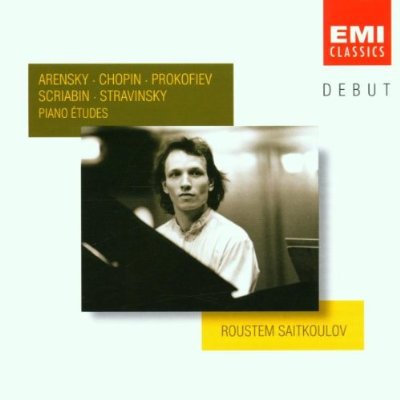
In the wake of the Lang Lang concert, I relistened to a recording of the Chopin op. 25 Etudes by Roustem Saitkoulov, a relatively young Russian pianist of Tatar descent. In 1999 he got the opportunity to record a very fine album for EMI in their Debut series dedicated to Etudes from an eclectic mix of composers (in addition to Chopin also the Russians Arensky, Stravinsky, Scriabin, and Prokofiev). However, after trailing the internet I must conclude that in the meantime his career has not been able to capitalise on this initial success. In any case, his discography is very limited. That does not diminish in any way the pleasure I've had over the years in listening to his rendering of the Chopin Etudes. It's a great interpretation and for me frankly remains the best I've heard. Saitkoulov welds the different strains in this music - supremely lyrical belcanto, romantic introspection, Lisztian grandeur, baroque sternness - into a compelling whole. His playing seems to conjure an effortless grandeur. There's even a symphonic dimension that emerges from his interpretation, with the first six Etudes coalescing in a long introduction of increasing complexity, Etude nr. 7 figuring as a marvelous slow movement, followed by a short scherzando intermezzo (8-9) and the final three Etudes as a monumental finale to the whole edifice. Here is an interesting study guide on the op. 25 that clearly shows what is involved in bringing these pieces to life. Following it alongside an audition of Saitkoulov's rendering deepened my admiration for his artistry. This is a recording I will often return to.

I then went back to Debussy's Etudes, more particularly the second book of the collection of 12. Over the past two weeks I've listened to them many, many times, contrasting three different readings. First, Uchida's justly celebrated 1990 recording on the Philips label (a Gramophone award at the time). Then the classic rendering by Monique Haas (1909-1987), recorded by Erato in the early 1970s. Finally I've been able to snap up an obscure LP with a recording of the Etudes by a Belgian pianist, Marcelle Mercenier (1920-1996; on the Musica Magna label). I've not been able to retrieve the recording date but I guess it is somewhere late 1960s, early 70s. Also, it's astonishing what little information there is to be found on the web regarding this pianist. Here is an obituary published in the Belgian francophone newspaper Le Soir, but that's about it. She taught in Bruxelles and Liège conservatories and was primarily active in the avant garde community. Stockhausen dedicated his first set of Klavierstücke to her. I must also have her recording of the Boesmans piano concerto in the OPL jubilee box.

Anyway, all of these recordings have something to offer. Mercenier is by far the slowest of them all, and yet her reading doesn't plod. It feels like a shadowy, tentative exploration of a complex, multi-layered universe. It's a very distinctive voice we are hearing here which doesn't really sound like Debussy (even like late Debussy). Only in the final etude ('pour les accords') her approach is too deliberate. Debussy allegedly felt this piece shouldn't sound too heavy and in Mercenier's approach it does. All in all a worthwhile reading that I will revisit.

Monique Haas' recordings Debussy recordings have a certain reputation. It's her second take on the Etudes, after her 1957 recording for DGG. Compared to Mercenier, her playing is much more bracing and edgy and brings out the modernist character of these pieces. Technically, the recording sounds a little coarse too, reinforcing the feeling of abrasiveness. This is a reading that asks for a certain commitment from the listener. But it's certainly interesting and worth repeated auditioning.

Uchida's version seems to be the best of all worlds. I admire the feline quality of her playing, investing these very difficult pieces with an amazing suppleness. With the Etudes Debussy moved out of his colouristic orbit into a more abstract universe. I feel they partake from the same spirit as his En blanc et noir, where he explored a much more neutral and steely palette. He went beyond 'impressionism', latching on to the strong, twisted lines of cubism. Not surprising, maybe, given his obsession with what went on in the trenches around him in those times. These are elusive pieces. You can continue to listen to them without ever getting the feeling of being intimate with them. And yet there is great beauty and dignity in these muted colours and strong contours.

zondag 26 februari 2012

J.S. Bach: Partita nr. 1 - Schubert: Piano Sonata nr. 21 - Chopin: Etudes op. 25

This week we were in a quiet place, spending time outdoors and discussing the future with friends and colleagues. There was hardly an opportunity to listen to music, but then I didn't feel like we missed something. All the more so as I had been stocking up on rich musical impressions at two live concerts just before we left. On Thursday (Feb 16th) I was graciously invited to attend a solo piano recital at Bozar featuring Lang Lang. I didn't know what to expect as I hadn't heard anything by this controversial musician. A genuine, larger-than-life artist or a billow of marketing-driven hot air? I had no idea. His eagerness to play the superstar role, however, raised my suspicions (reminding me of that other enfant terrible I've never been able to really take seriously, Nigel Kennedy). So there we were in a chock-full Henry Le Boeuf Hall with more than 2000 people in eager and noisy attendance (with a contingent of 150 seated at the podium facing the main hall). The good and great were amply represented. At the cloakroom I ran into Viviane Reding, Vice-President of the European Commission, and Commissioner for Justice, Fundamental Rights and Citizenship, but in my haste sadly forgot to wisper her a word of caution as the spirit of the European project potentially derails under the iron grip of a blind oligarchy. Lang Lang had a Bozar spokesperson especially request a silent demeanour (no coughing, no cell phones) by the audience during the performance. It proved to be fruitless because as the concert unfolded the audience became more and more difficult to restrain. There was plenty of coughing from the start and after the break, the Chopin Etudes were interrupted three times by clamorous applause. And in the final Etude there was indeed a cell phone that (as I experienced it) artlessly and interminably brought the concert to a premature end. But despite those intrusions it was a memorable concert. And then I'm thinking particularly of that great, last Schubert sonata (D. 960) which Lang Lang presented as the story of a life compressed in just 40 minutes. Despite the almost unbearable tension in the hall brought about by an audience that was anxiously trying to gutturally restrain itself, Lang Lang made no concessions and played this valedictory sonata in the most intimate manner, taking his time to sculpt every note and colour every chord in the most exquisite manner. It was quite obvious that here is a pianist with prodigious technical powers, whose musical imagination is the only limit to what his artistry is able to produce. His Bach Partita surprised me by its old-fashionedness, eschewing the percussive clarity that is nowadays 'de rigeur', occasionally meshing the voices, stressing the legato character and indulging in a rich, creamy rubato. I'm personally not offended by a romantic, lyrical interpretation of Bach's keyboard works and happily took it in stride, intrigued as I was by the remarkable technical facility displayed by the pianist. What also surprised me was Lang Lang's sober mien behind the keyboard with very little of the histrionics that for some reason I was led to expect. By the time he broached the Chopin Etudes - which he has been playing since he was 13 - there was no doubt Lang Lang was up to the task. However, for me Chopin's opus 25 needs to be played in one sweep in order to reveal the almost symphonic architecture underpinning this monumental piece. That, rather than the endless possbilities for virtuoso display is what makes this such a compelling experience. With all the audience interruptions Lang Lang's performance, whatever its merits, became for me rather pointless. As said, the unquestionable highlight of the evening was in my opinion a truly great Schubert sonata. Perhaps too meandering and disjointed for some tastes, but I still marvel at Lang Lang's amazing colouristic abilities, conjuring washes of colour with a sleight of hand. Again, there is no doubt that this is an artist of extraordinary abilities. The risk is, I feel, that these capabilities do not find a sufficiently disciplined and deeply rooted vessel to contain them. Lang Lang's art is rich, very rich and at a certain point this opulence may teeter into the manierist, the facile or simply the bombastic. As a kind of litmus test I'd love to hear him in Debussy where the ascetic and the luxuriant seamlessly mesh. Will he be able to keep the 'juste milieu'? After the concert the affable star was signing autographs in the Bozar shop. I asked him and he said eventually he will be happy to record some Debussy. May take a while, though. Meanwhile we'll follow with interest. Thanks again to KDK and WVDH for the treat.

vrijdag 17 december 2010

Der Bote - A Lubimov recital

Listened twice this week to this wonderful recital recorded by Alexei Lubimov. Why don't we have more of these intelligent and adventurous compilations, rather than perennial rehashes of the core repertoire? I'm transcribing Lubimov's own liner notes here:

Melancholy - that is the title one might give to this programme. Nostalgic pictures, some will suggest, and others: quiet meditation. Music written for oneself, one might also think; like a diary not meant for publication, in which you note down only what is most personal, what is memorable for no one but you and yet says a great deal.
Whatever else these collected pieces may be given, one or two words are not enough to show why these unpretentious masterpieces from three centuries so smoothly gather into a single strand that unravels a bundle of associations and memories so dear to their performer. Within these composers' works each piece holds a fairly modest place: in most cases it is but a marginal note in a long novel. However, linked together here by their unassuming, meditative poetry and the deeper inner impulse of their creators, who are not inhibited by any commission or external circumstance, they convey a particular significance to me - and to my listeners too, I hope - with its own logic and atmosphere. Thus what we have here is the story of a sort of journey, each stage of which is meant not so much to reveal the composer's soul as to bring us gradually closer to that essential source from which all these musical compositions draw their kinship and to which they owe their inner unity.
Then it no longer seems strange that Silvestrov's Messenger (Der Bote) should sound as if it had come straight out of the 18th century and C.P.E. Bach's Fantasia should appear nearly the most modern piece in the programme (Cage's In a Landscape); that the gentle wistfulness of Glinka's Parting (La Séparation) and the almost Brahms-like bitterness of Chopin's Prelude Op. 45 should have as their perfect counterparts the aloofness and chaste restraint of the elegies by Liszt, Bartok and Debussy; that Mansurian's Nostalgia and Silvestrov's Elegy should point regretfully to the fact that even the radical changes that followed Webern have vanished in a nostalgic past; and that the most avant-garde composer of the 20th century - John Cage - should present us with a most delicate and poetic flower, a genuine East Indian lotus flower floating away on a sea of oblivion ... Oblivion? - There is no such thing as oblivion, Silvestrov says with his Messenger; it is enough to fling open a window, to strike a match, to look at a cloud, to hear a triad, for memories - not only ours but also those, unknown to us, of all these messengers - to start working a miracle.